
Treatment
Renal Embolization
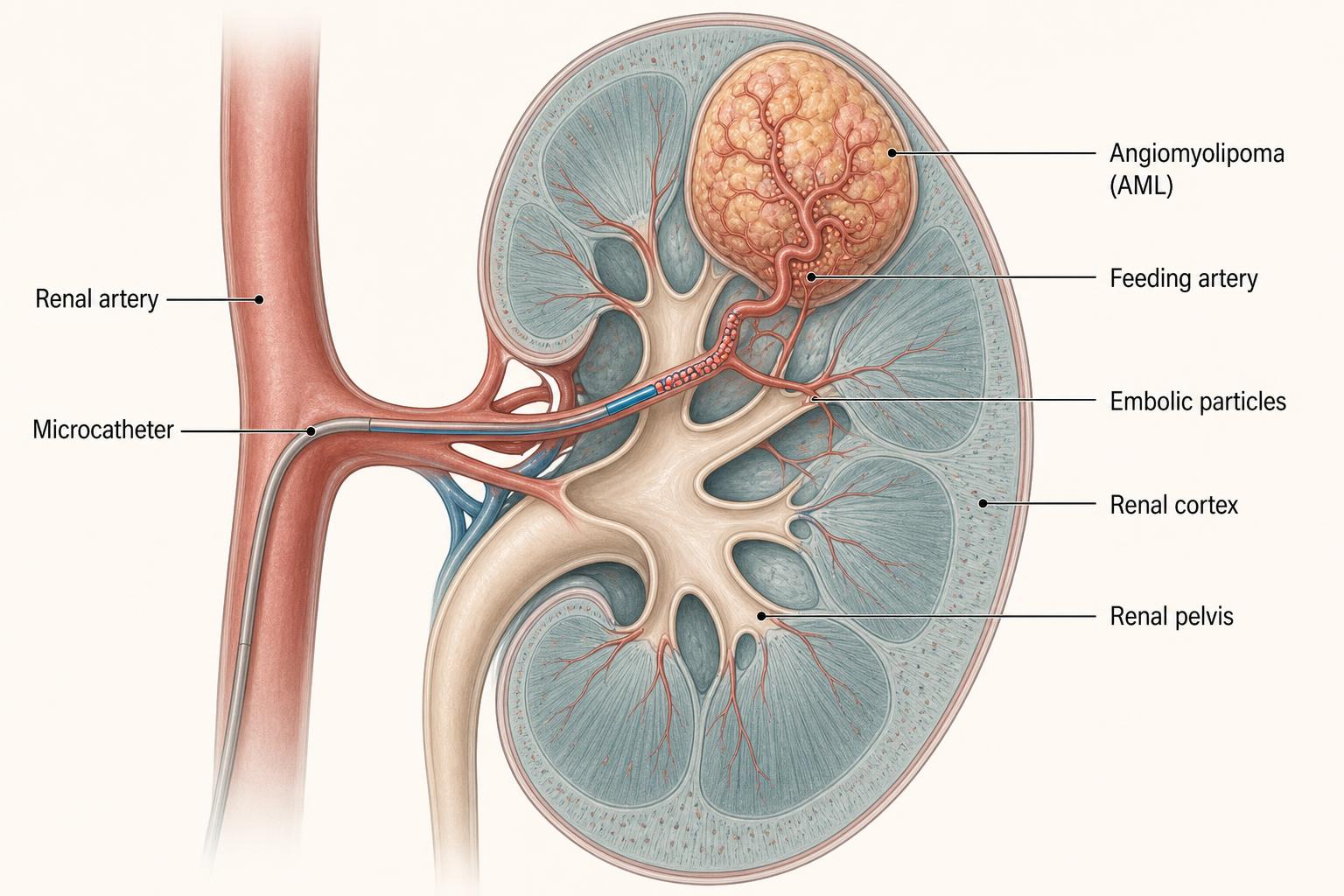
Renal embolization uses tiny particles delivered through a pinhole catheter to stop the growth of renal masses such as angiomyolipomas, without surgery.
What it is
An image-guided procedure that selectively blocks the blood supply to a kidney lesion, shrinking it and reducing the risk of bleeding while preserving healthy kidney tissue.
Best suited for
- Patients with growing angiomyolipomas (AMLs) at risk of bleeding.
- Renal masses where nephron preservation is a priority.
- Pre-operative devascularization before partial nephrectomy.
How it works
- 1Small access in the wrist or groin under local anesthesia.
- 2A microcatheter is navigated into the artery feeding the lesion.
- 3Embolic particles are delivered to block blood flow precisely.
- 4Follow-up imaging confirms shrinkage and stability.
Benefits
- Preserves kidney function compared with surgery.
- Lowers the risk of life-threatening bleeding from AMLs.
- No surgical incision.
Possible risks
- Post-embolization syndrome (low-grade fever, flank pain) for a few days.
- Rare non-target embolization.
- Occasional need for a repeat treatment.
Used to treat
Conditions Dr. Rastinehad treats with Renal Embolization.
FAQ
About Renal Embolization
Answers patients most commonly ask before their consultation.
Embolization is selective; surrounding healthy tissue is preserved and overall function is typically maintained.
Ready to talk?
Personalized urologic care begins with a conversation.
Schedule a consultation to review your imaging, lab work, and treatment options.